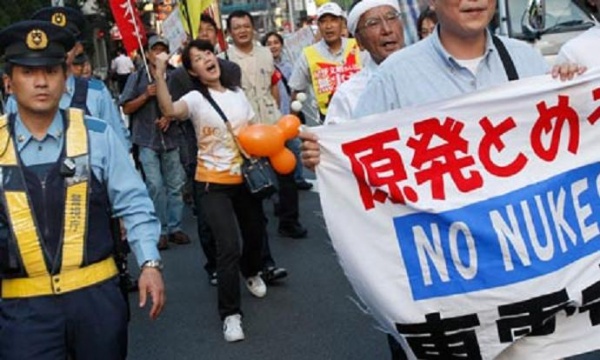
イギリスーガーデン新聞(6月30日号)?の福島原発事故関連「6~16歳尿からセシウム 福島市民団体調査」記事に原発反対デモとして「原発止めろ!新橋アクション」デモ写真が載りました!
Fukushima children test positive for internal radiation exposure
Traces of caesium-134 and 137 isotopes found in urine tests on 10 children in city near stricken nuclear power pant Demonstrators pass the headquarters of Tokyo Electric Power Co, the operator of tsunami-hit Fukushima Daiichi nuclear plant, during an anti-nuclear power protest in Tokyo on Thursday. Photograph: Shizuo Kambayashi/AP Trace amounts of radioactive substances have been found in urine samples taken from children from Fukushima city, raising concerns that residents have been exposed internally to radiation from the stricken nuclear power plant 37 miles (60km) away. Tests were conducted in May on 10 children, aged between 6 and 16, by a Japanese civic group and Acro, a French body that measures radioactivity. All 10 tested positive for tiny amounts of caesium-134 and caesium-137. The chief cabinet secretary, Yukio Edano, said he was concerned by the findings and the government would thoroughly examine the results. The Fukushima network to save children from radiation said it was certain the readings were due to radiation leaks from the power plant, where workers are still struggling to stabilise reactors that suffered core meltdowns after the 11 March earthquake and tsunami. Acro’s president, David Boilley, said the results suggested a strong likelihood that children living in or near Fukushima city had been exposed to radiation internally. According to the survey, 1.13 becquerels of caesium-134 per litre of urine were found in an eight-year-old girl – the highest reading for that isotope. The highest reading for caesium-137 – 1.30 becquerels – came from a seven-year-old boy, Kyodo news agency said. Richard Wakeford, an expert in radiation exposure at the Dalton Institute in Manchester , said he was not surprised that caesium had been found in Fukushima city residents, given the distance and direction the radiation plume had travelled. “What we’re seeing here is residual caesium that will be around for quite a while,” he said. “But, given the circumstances, the levels quoted in the survey are not particularly alarming.” Wakeford said ingestion could be prevented by avoiding contaminated food and milk, but added that produce contaminated at levels acceptable to the government would inevitably go on sale. The discovery came days after health authorities in Fukushima began checking internal radiation doses among all 2 million of the prefecture’s residents, a 30-year project that will cost an estimated 100bn yen (£777m). In separate tests, radioactive caesium and iodine were found in the urine of 15 residents from two towns located 19 to 25 miles from the Fukushima Daiichi plant. While none had exceeded the maximum allowable dose of 20 millisieverts a year, experts voiced concern over the presence of caesium-137, a byproduct of nuclear fission with a half-life of 30 years. “This won’t be a problem if they don’t eat vegetables or other contaminated products,” Nanao Kamada, professor emeritus of radiation biology at Hiroshima University , told reporters. “But it will be difficult for people to continue living in these areas.” From September tens of thousands of children living in Fukushima city are to be given dosimeters to measure their exposure to atmospheric radiation. Environmental groups have called for pregnant women and children to be evacuated from the city. Children are thought to be at greatest risk because they have more time to develop thyroid and other cancers. “At least parts of the population that are sensitive need to be evacuated, and the remaining people who decide to stay for various reasons need to be given proper support and information,” said Jan Beranek, head of Greenpeace’s energy campaign. Wakeford said: “I wouldn’t say immediate evacuation is required because this is not a sudden burst of radiation. It’s long-term, protracted exposure. The Japanese government’s biggest problem is deciding on what kind of external levels of exposure are acceptable once the crisis has moved out of the emergency phase.”
毎日新聞 6月30日(木)20時26分配信
放射性物質 6~16歳尿からセシウム福島市民団体調査
福島県内の保護者らで作る市民団体「子どもたちを放射能から守る福島ネットワーク」などは30日、福島第1原発事故の子どもたちへの影響を調べるため、福島市内在住の6~16歳の男女10人の尿検査を実施したところ、全員から放射性物質のセシウムが検出されたと発表した。同ネットワークは「福島市や周辺の子供たちも内部被ばくしている可能性が高い」として、全身の内部被ばく線量を測るホールボディーカウンターによる早期の検査実施などを求めている。
会見した同ネットワークによると、5月20~22日に採った尿を放射性物質を調査するフランスの民間団体「ACRO(アクロ)」に依頼して解析。セシウム134(半減期2年)が1リットルあたり0.41~1.13ベクレル、セシウム137(同30年)が、1リットルあたり0.43~1.30ベクレルだった。ACROのデービッド・ボアイエ理事長によると、事故前はゼロだったと推測されるという。
今回の測定値について、内閣府原子力安全委員会の班目春樹委員長は30日の臨時会議後、「十分低い値。健康への影響は疫学的に考えられない」との認識を示した。そのうえで、継続的に子どもの健康を管理するシステムを構築するよう国に求めた。【久野華代、比嘉洋】
